
Rainbow Hope
Telling the whole story and not stopping halfway

In early January of 2026 I was giving a sermon at a church camp in Australia and I had prepared words to share long before I arrived. But as I sat at the camp’s Sunset Reflection service on Tuesday night, a different message began to emerge in my mind. I thought it might be a message for some other time, but later on at the evening worship, as I listened to testimonies about prayer and about God’s work in our lives, it became clear that the message wanted to be shared that week.
One of the stories I heard that week was of the flood in Taree that impacted members of the Australian church community, and the hope that they have found in spite of great loss. I also heard that many of their congregations face uncertainties as they look toward transitions in the future - buildings that no longer serve as well as they once did, perhaps ways of gathering that are no longer a good fit, or new ways that are exciting but a little scary too, maybe wondering about who will be the leaders of tomorrow.
Around the world, we face similar adversity. Climate change has deeply impacted many places that face record floods, destructive weather, and less habitable conditions. We face uncertainty about the institutions and structures of society that have previously seemed unmovable and unchangeable that now seem tenuous and subject to the whims of a wealthy few. Around the church of the western world - not just in Community of Christ - we see the increasing secularization of society impacting our ability to find ways to be relevant in our communities.
Perhaps we feel like Noah, arks floating in a flood of trouble and difficulty. Holding on to one another, wishing for the less stormy seas of the past.
Or maybe we feel like we have fallen from the tower of Babel - unable to understand one another. Not knowing if we are chatting with a human being or a bot, trying to communicate but feeling like even between generations we no longer speak the same language.
In the midst of this poly-crisis of trouble in the world I want to remind you of two ancient signs of hope: the rainbow God offered to Noah, and the Pentecost spirit that brought people together because of their differences.
In the story of the flood in Genesis we have a world that God is unhappy with and wants to destroy. This is not an image of God we talk about often or resonate with these days in Community of Christ. It’s uncomfortable to sit with the idea of a deity that could purposefully inflict harm on their creation. Just recently someone was telling me about how they had been teaching a child about how God has created everything, and the young child responded “God even made the corona virus??” What a great question! Questions like that are what have kept me engaged as a disciple all these years. The creation story in Genesis doesn’t explain viruses. And if God did create the virus, what does that say about what God thinks of us? Big questions. But I believe that questions are always a demonstration of deep faith. And I find that if we try to explain it all away with tidy answers - like Job’s friends did - we tend to dig ourselves into deeper holes. Instead I like to say “I don’t know, it’s part of the divine mystery, but regardless of the answer, how should we live our lives today?”
In the fall of 2025 I got to visit Ireland and meet two spiritual seekers there who, in asking the big questions and searching online for answers, came across Community of Christ. There are no Community of Christ congregations in Ireland, there is one member in Northern Ireland, but that is a long way from the small town a few hours south of Dublin where these two seekers live. They grew up in the Catholic Church, as did most of their peers, but both have longed for something different, a faith that could include their transgender friends, leaders that acknowledge the reality of climate change, a community that would support them in all parts of their human journey. And so they met online with someone in the UK and after several months of connection, one decided he wanted to be baptized and begin sharing Community of Christ’s message in the place where he lives.
The day after the baptism (in the Irish Sea in October! What an example of committed discipleship!) we were walking around the city of Carlow, talking about questions of faith. I was deep in discussion with one of these seekers about the nature of God, walking around the running track of a sports field that was surrounded by trees. He had just asked “how do you reconcile the idea of a vengeful God in the Old Testament with the story of a loving God in the New Testament?’ You know - just a light little question! And as I tried to formulate an answer, we rounded the corner of the track, I looked up, and above the trees I saw a faint but distinct rainbow stretching across the sky. (This, by the way, would be the third of four rainbows I saw during my five week trip around Europe.) But in this particular moment I was incredibly grateful for this gift of the most perfect object lesson. (And, apologies if this is a disappointment, but there was no leprechaun or pot of gold, in spite of the fact we were in Ireland.)
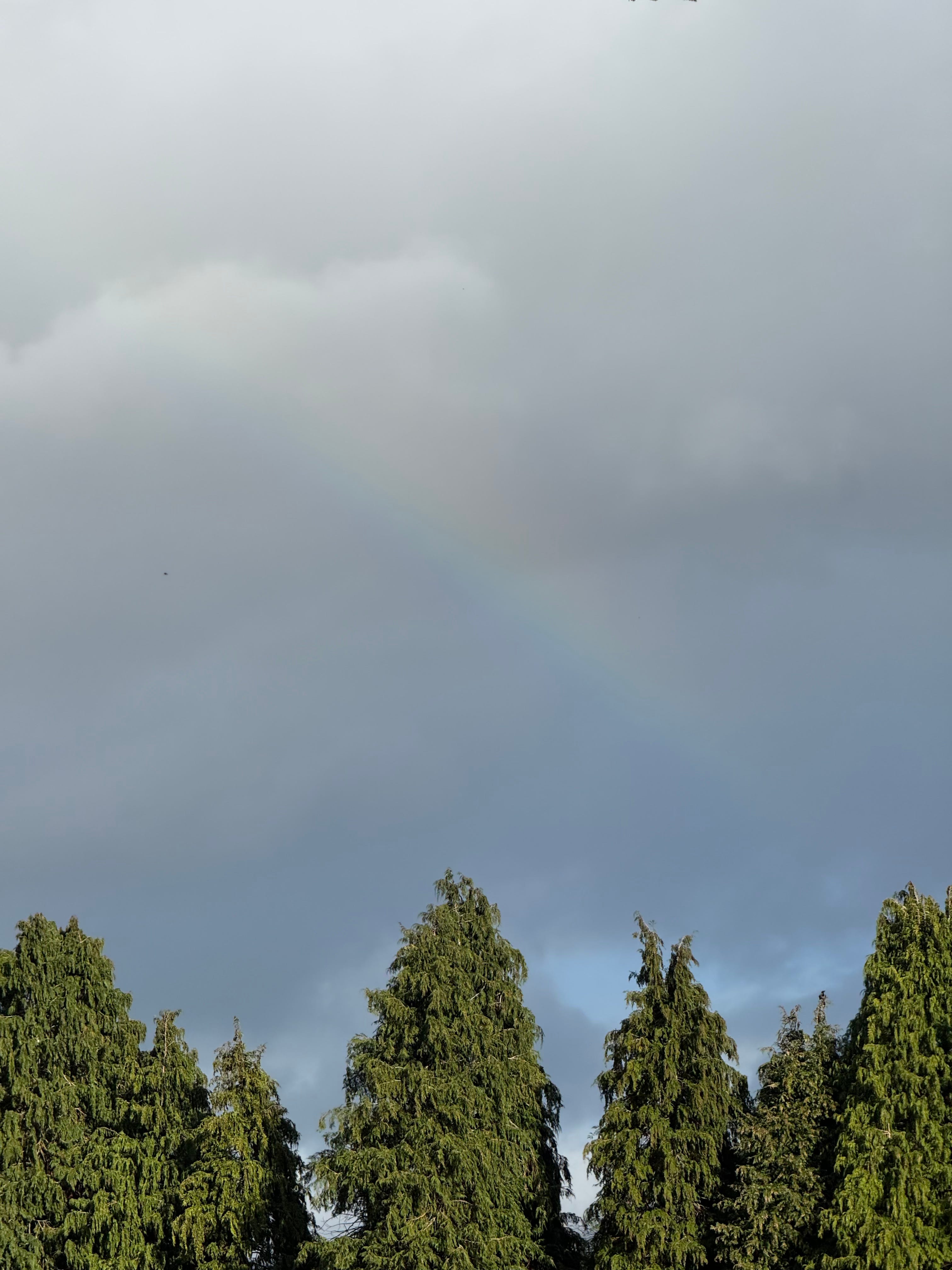
No, at sight of this rainbow, and considering the question about a vengeful God, my mind was transported directly back to my Torah class with Jim Lindenberger at Vancouver School of Theology in 2003. Jim, a tall man with a white beard, could have easily been the artist’s model for a renaissance painting of God the Father. And he was talking about the story of the flood not just from the perspective of a Hebrew Bible professor but also as a minister to us questioning students. I clearly remember Jim talking about the Rainbow that comes after the flood as a sign of God’s evolving relationship with God’s people. The word for rainbow in Hebrew has the same root as the word for a hunting bow - just like in English. And I remember Jim miming the act of a hunter hanging up a bow as a demonstration of leaving behind the vengefulness of the past for a new way of being the creator of all. The rainbow as that bow - which every time we see it, can remind us that the God we follow has resigned the hunt and committed to loving God’s beloved creation.
With the rainbow hanging in the sky there above Carlow, I was overcome with gratitude for God’s work in the world - that when we pay attention - often to the natural world, the answers we are seeking will show up for us. I related my of story Jim’s class to these two seekers and I saw shimmers of understanding and insight flicker across their faces. It turned out I didn’t have to formulate an answer to that difficult question out of my own mind, God’s creation itself led me to the right words to say.
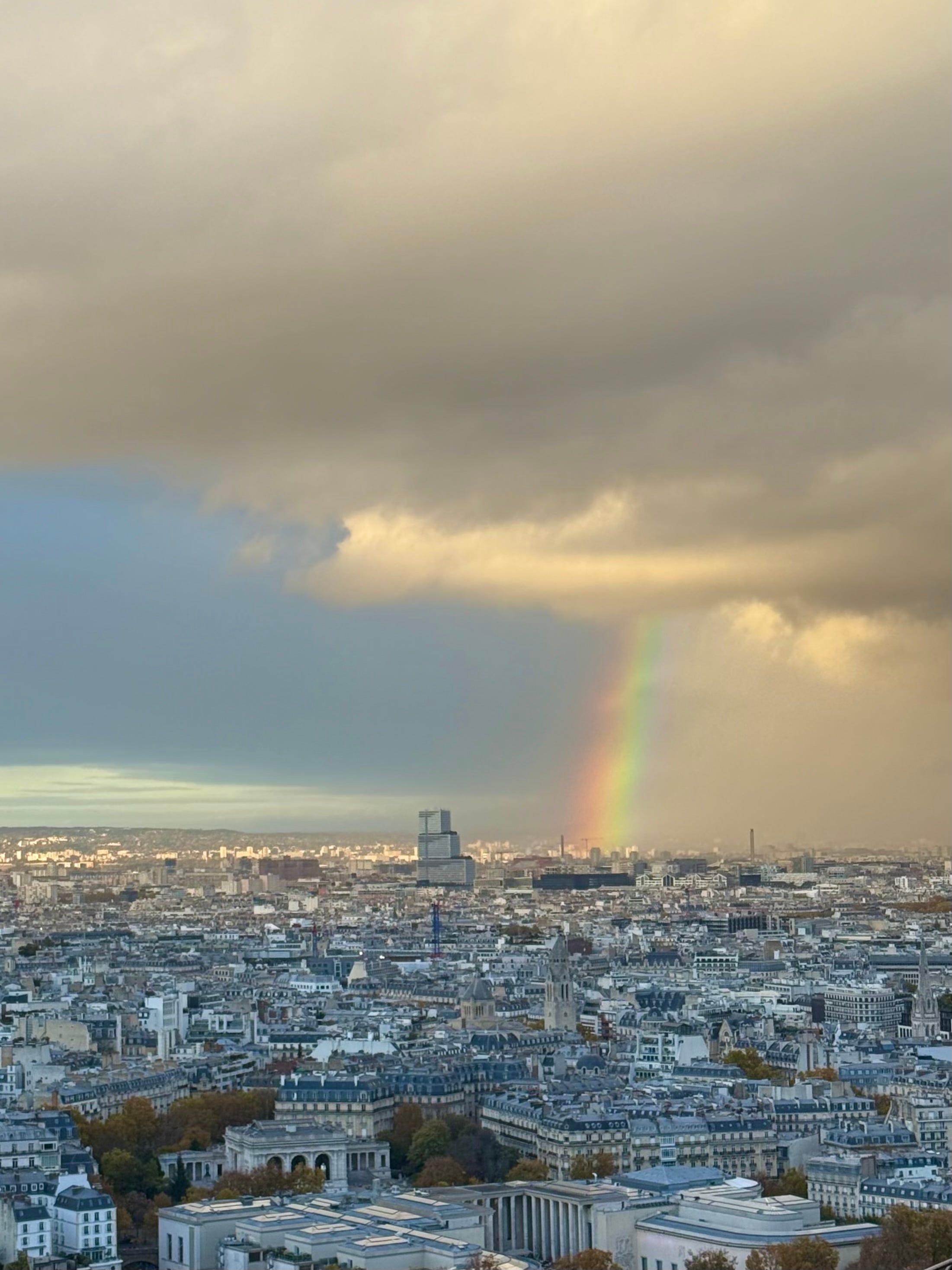
The first rainbow of hope that trip had appeared near Pendle Hill in England where George Fox, founder of the Quakers, had received his vision of divine light present in all people. The second rainbow of hope appeared across the sky in Scotland as we walked through a park with a seeker there, who is wrestling with many questions of faith. The fourth appeared when I was on the second floor of the Eiffel Tower, looking out over Paris. Tired and in the fifth week of my trip, the brightness and intensity of the colours stretching over the grey rainy city restored my hope that I could make it through to the end of that particular journey.
So, imagine my delight when, on Tuesday night of this reunion, I was handed a program at Sunset Reflections that had a rainbow stretched across the front cover! As I listened to the diverse stories of hope in action, hope in the diversity of voices and colours, and the blessings of community, I witnessed a rainbow again. Not a literal one, but the rainbow of the faith and discipleship I was witnessing.
This diversity of voices points to the second place where I find hope - the story of Pentecost! Disciples from many places (there are three full verses that just list of all the places these disciples are from!) had gathered in one place ten days after Jesus’ final appearance to them. A rushing of wind unexpectedly swept through them. The air element of the earth bringing the Holy Spirit - Ruach in Hebrew, Pneuma in Greek - that spirit that is also wind and also breath.
This rushing of the Holy Spirit comes upon all of them - no one is passed over, and all are empowered! Miraculously, even though they all spoke different languages, everyone suddenly understood each other. It’s so miraculous that people question it! “What does this mean?” they ask “These people must have been drinking!” They exclaim.
Peter particularly was transformed. Once the wishy-washy disciple who thought he was a failure, Peter preaches a rousing sermon and will become known as the rock on which the church is built. As followers of Christ, Peter and the other disciples were determined to continue Jesus’ ministry of defying empire and choosing God’s empire of love instead of the Roman Empire.
Peter tells those gathered to be baptized as followers of Christ and that they will receive the gift of the Holy Spirit. Just as I witnessed in the baptisms and confirmations of new disciples in every place I’ve visited the past year! From their step into commitment comes a renewal of the Holy Spirit in them, and also, I would venture, in all who are witnesses. In their commitment we can all be invigorated and confirmed in the Holy Spirit that comes to each one of us.
Peter boldly declares that this gift of the presence of the Holy Spirit that is working in them is a Spirit that will also go out to others, even those far away. Out of this experience those gathered go forth to build a community where people take care of one another. They share what they have and give of themselves for the greater good. They embrace a life of loving one another and loving their neighbours - near and far. Loving one another in word and in deed.
Quite the opposite of the tower of Babel story, where people are divided by their differences, Pentecost teaches us that it is in fact difference that allows us to see the Holy Spirit showing up! If everyone had been the same and understood each other - they would not have known that the Holy Spirit was moving there amongst them! Their diversity revealed the Holy Spirit.
As I have travelled the past year to places where I had never before experienced the context, language, or culture, I have been delighted to find connection everywhere, delighted to see the Holy Spirit showing up in beautiful and surprising ways. Most of my summer was spent attending Canadian camps and reunions to help move two very different mission centres toward becoming one. As I listened to many concerns and worries about what the change would mean I was amazed by how willing people were to approach the merge with curiosity, kindness, and hope. One person said that just because Canadian politics divides and pits east against west, doesn’t mean we have to do the same in the church - in fact, the church should be the place where we learn to understand our differences and be inclusive of all, despite what usually separates us.
And here is where our rainbow of hope, reassuring us of God’s love, overlaps with Pentecost, because I love that the rainbow has also become a symbol of inclusion and diversity in our world today. I have always imagined Pentecost with fiery red and orange colours, but what if Pentecost actually looks more like a spectrum of many colours - bright, pastel, light, dark, all welcome in our communities and at our tables.
Every time we join together at the table of communion or the table of a meal, we partake together in a meal of hope. And these are not our tables, these are Christ’s tables. And at Christ’s tables, all are welcome. We read many times in the scriptures of how Jesus ate with people no one else would eat with. His radical welcome and openness are our model.
By coming together at communion and shared meals, we join in the sacred act of being together at table as one body regardless of who we are, what we think we’ve done, or what we know we’ve done, as a rainbow community, as our ordinary, imperfect selves.
Let the communion table of “love poured out” seamlessly blend with all the tables you gather at, may each table you sit at be an extension of Christ’s table and the holy act of breaking bread together. The world desperately needs our tables of grace, our meals of hope, where people can show up just as they are, where all are welcome, none are turned away, and all are filled, where the miracle of Pentecost can happen over and over again.
These two ancient stories of faith I’ve shared today, of the rainbow that signals God’s love for us and the Pentecost spirit that brings us together in our differences, both teach us how to find hope in these hopeless times.
There are powerful voices in the world today who want the story to stop half way - they want only the vengeful God of the flood, not the God who changes and hangs up the hunting bow in the sky. They want only the confusion, division, and distrust of difference at the tower of Babel, not the miracle of Pentecost where difference is what brings people together and reveals the holy spirit.
It is our call and our duty to tell the rest of the story - to choose hope.
So whether it is paying attention to the ways that God will speak through creation to bring you hope or trusting that especially when you are with people very different from yourself, you will experience the Holy Spirit, trust that when you choose hope it will always meet you when you need it most. Amen.